
We are now just a few days from Ottawa’s municipal election on October 26th, 2026. Candidates are busy ensuring their existing supporters turnout and trying to convert persuadable supporters of other candidates to change their mind and switch their votes. This release examines the potential for people to move and how that would likely affect the outcome.
Quorus Consulting conducted a survey of 807 Ottawa residents from October 8 to 15.
Whose Votes Are Locked-In? What Voters May Switch?
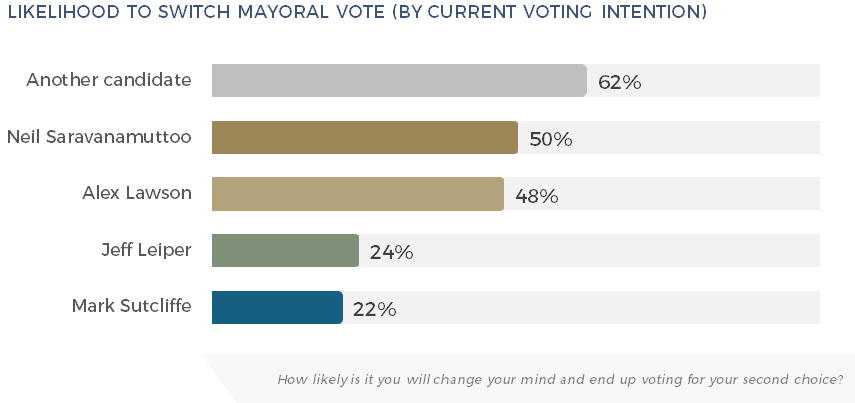
The most locked-in voters are those who are for Mark Sutcliffe (only 22% likely to change) or Jeff Leiper (24%). For each of the other main candidates, about half say they are likely to switch between when we interviewed and when they would be casting their ballot.
Overall, 32% of people who offer a vote choice say they are at least somewhat likely to change their vote by the time they cast their ballot.
Of these potential switchers who name a second choice, Sutcliffe has the most support (27%), while support is fairly evenly divided among Jeff Leiper (20%), Neil Saravanamuttoo (20%), and Alex Lawson (15%).
Younger voters, men, renters and those with university educations are all more likely than others to switch their vote.
Strategic Voting Likely to Widen Sutcliffe’s Lead
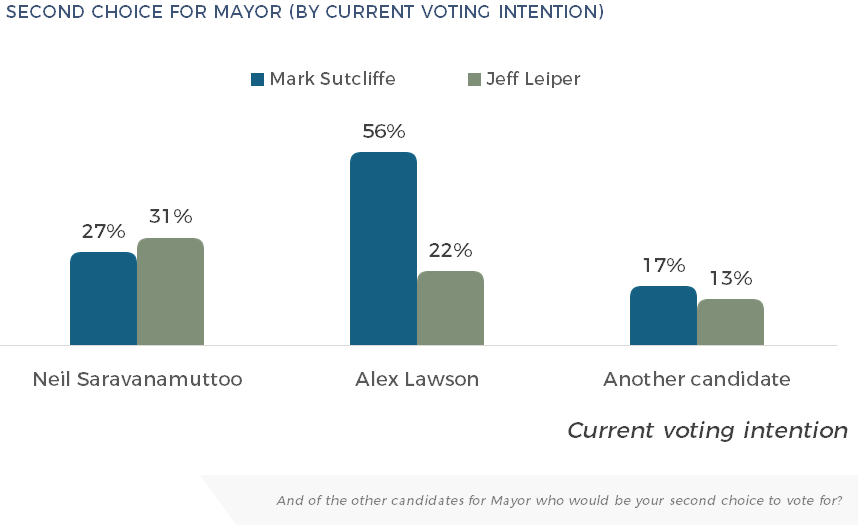
Strategic voting is when a voter feels that it is pointless to vote for their preferred candidate and decides to vote for another in order to avoid having a leading candidate win. With Mark Sutcliffe and Jeff Leiper well ahead of the other contenders, and assuming voters are aware of that, then voters whose first choice would be Neil Saravanamuttoo, Alex Lawson or some other candidate are the ones who might reasonably switch on a strategic basis. On this analysis, Mark Sutcliffe again has an edge:
Neil’s voters are fairly evenly split between Mark and Jeff as their second choice, suggesting little impact on the difference between the two leading candidates.
Alex’s voters are twice as inclined to switch to Mark than to Jeff, suggesting that Mark may gain a net benefit among those voters.
Taken together, while it does seem likely that a considerable number of “decided” voters say they are likely to switch, their responses – particularly among those most likely to feel their preferred candidate is unlikely to win – suggest that doing so tends to benefit the incumbent Mayor Sutcliffe more than the top challenger, Jeff Leiper.
Who Will Get Their Voters Out
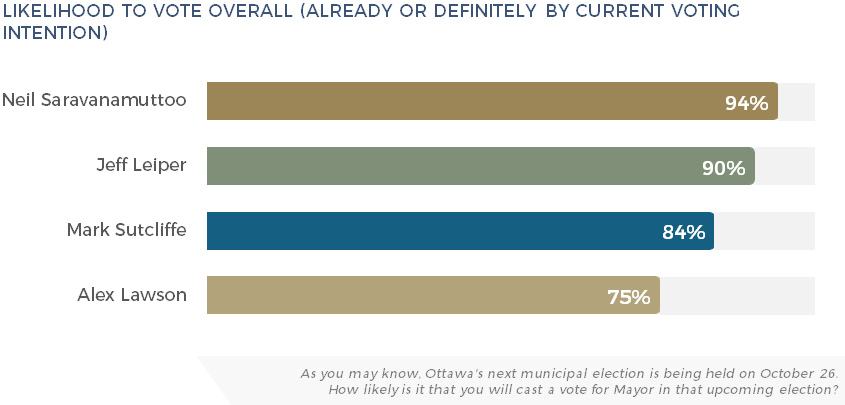
Although it’s not about strategic voting, one more key factor that may influence the outcome – or at least make it closer than it appears at this moment – is the varying rates of turnout among each candidate’s supporters. All the main candidates find roughly the same proportions having already cast their ballot – between 12% and 15% of supporters. When combined with the proportion claiming they will definitely vote, Saravanamuttoo has the voters with the highest claimed likelihood to turn out (90%). Leiper (90%) has the second most engaged, with Sutcliffe (83%) and Lawson (76%) having slightly less reliable turnout.
If Leiper gets 90% of his supports to ultimately vote and Sutcliffe only 83%, the gap between them would be reduced.
Based on these numbers, the campaigns should be working very hard this weekend and on Monday. One would expect the Sutcliffe team will be appealing to both Lawson’s and Saravanamuttoo’s supporters to switch their support to him in order to stop Leiper from winning, while Leiper will be addressing Saravanamuttoo’s supporters, as well as those of the many other candidates that changes they seek are possible if they switch to supporting him. And of course, all will be seeking to maximize the turnout of their own supporters.
Click HERE to download data table 1 for this report.
Click HERE to download data table 2 for this report.
Click HERE to download data table 3 for this report.
Click HERE to download data table 4 for this report.
Click HERE to download data table 5 for this report.
What is the Quorus metroVox?
Every quarter, Quorus conducts an online survey of n=500 residents of the NCR (400 in Ottawa and 100 in Gatineau), with sampling carefully controlled to be reflective of residents 18 years of age and older. To cover the Ottawa mayoral race, this special edition of the metroVox was held with over n=900 residents of the NCR (807 in Ottawa and 151 in Gatineau).
The survey results presented in this document were derived from a study designed, executed and sponsored by Quorus Consulting. They represent the opinions of 807 randomly selected members of Leger’s opt-in panel, Ottawa residents, 18 years of age and older, who completed an online survey between October 8-15, 2026.
The data are weighted to replicate actual population distributions by age and gender within region, according to the most recent Census data available. A margin of error could not be calculated due to the use of a non-probability sample, i.e. respondents were selected only from among those who had registered to participate in online surveys through a panel. Respondents had the option to complete the survey in either English or French.
To inquire about our research findings or media availability, contact This email address is being protected from spambots. You need JavaScript enabled to view it. (613-293-2312)
 Accredited Member of CRIC