
With Ottawa’s next municipal election coming up on October 26th, 2026, it’s a good time to understand what residents think of how well their municipal government is performing.
Quorus Consulting conducted a survey of 403 Ottawa residents from June 16 to 23 to understand citizens’ performance ratings of the Mayor, their Councillor and City Hall itself, as well as what they want the government to focus on and how all of that relates to their voting decision.
The general mood is “mid” rather than angry
Ottawans are not delivering a sweeping rejection of their municipal government, but they are not enthusiastic about its performance either. Residents are fairly positive about their own ward councillor, somewhat less positive about Mayor Mark Sutcliffe, and essentially divided on the performance of the City of Ottawa as an institution. The result is a public mood that looks more demanding than angry: many residents are prepared to give current office-holders credit, while still seeing substantial room for improvement in how the city works.
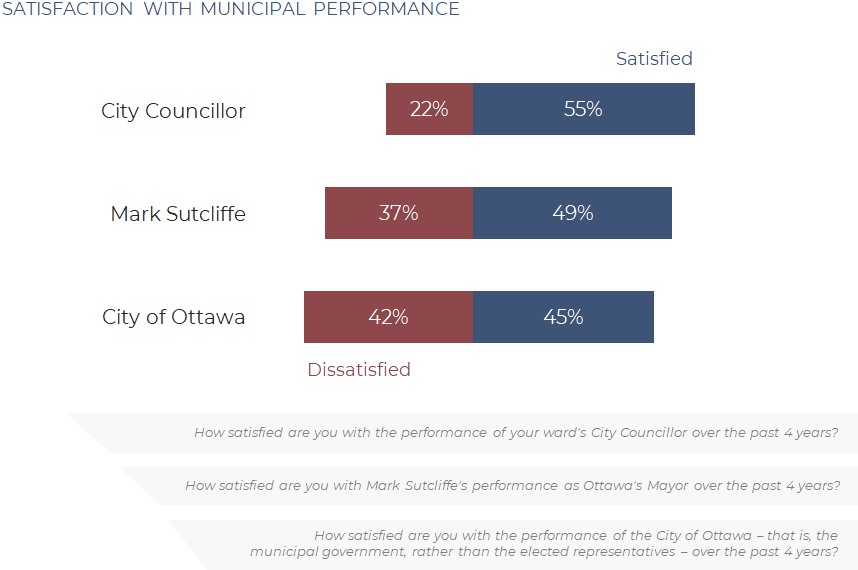
That distinction on satisfaction matters politically. Satisfaction with current performance is strongly associated with support for continuity in the mayor's office, while dissatisfaction is strongly associated with support for change, at least in terms of who holds the position of Mayor. Among decided voters who are satisfied with Sutcliffe's performance, 79% intend to vote for him; among those dissatisfied with his performance, 83% support one of his challengers. The same pattern appears when residents judge the municipal government rather than the Mayor personally: 73% of decided voters who are satisfied with the City's performance support Sutcliffe, while 74% of those dissatisfied support a challenger. The election therefore has a clear status-quo dimension, although these crosstabs demonstrate association rather than causation.
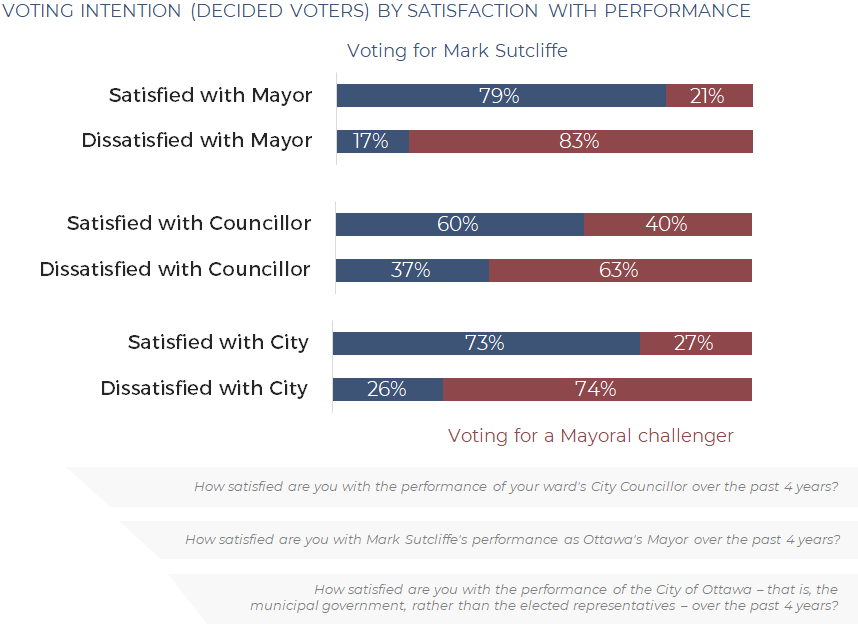
Taken together, the findings suggest that the 2026 municipal debate is likely to be less about a generalized desire to throw everyone out – certainly, little desire to throw incumbent Councillors out – than about confidence in municipal competence and service delivery.
The agenda, however, is unmistakable: Make it easier to get around the city!
Public transit is by far the most broadly shared priority. When residents are shown a list and allowed to choose up to three priorities for the next Mayor and Council, 50% select public transit. Housing and homelessness are tied for a distant second at 34% each, followed by traffic congestion at 25%, managing the City's funds/budget at 22%, crime at 21%, property tax at 18%, public health and the local economy at 15% each, and addiction/opioids at 14%.
The open-ended results make the transit finding more compelling. Without being shown any issues, 42% of residents mention public transit or LRT as an urgent priority. When given an open text-box to write in their top priority, just over half (53%) say something that falls into a broader urban infrastructure and transportation category. Housing affordability is volunteered by 23%, road and infrastructure maintenance by 18%, homelessness by 16%, cost of living/inflation by 14%, taxes/property-tax increases by 12%, and crime/public safety by 12%.
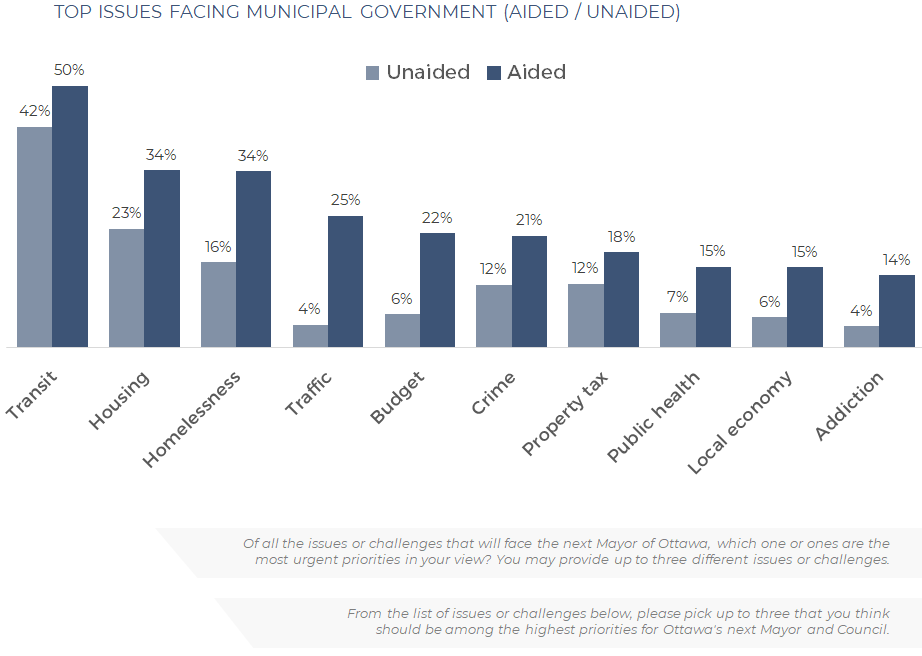
The contrast between the prompted and unprompted questions helps separate issues that are broadly regarded as important from issues that are truly top-of-mind. Transit performs strongly under both approaches: 50% prompted and 42% unaided. Other issues rise more sharply once residents are reminded of them. For example, managing the City's funds/budget is selected by 22% from the list, while only 6% spontaneously mention City budget/fiscal responsibility. Crime is selected by 21% when prompted and only a top-of-mind priority for 12%. Homelessness is 34% prompted and 16% unaided.
Transit is therefore not simply one priority among many; it is the issue most firmly embedded in residents' spontaneous understanding of what City Hall needs to address.
Different groups emphasize different problems, but the core agenda is broadly shared
Age produces some of the clearest differences in citizen priorities. When provided with a list of 16 issues (as well as the opportunity to name another), residents aged 55 and older are especially likely to identify transit as a priority (57%, compared with 44% among those aged 35-54) and are also more likely to prioritize management of the City's finances (31%, compared with 14% among those aged 35-54). Younger adults aged 18-34 are more likely than those aged 35-54 to prioritize homelessness (42% versus 26%).
Among the few differences by gender, men are more likely than women to choose management of the City's funds/budget (28% versus 16%), while women are more likely to identify public health (19% versus 11%). Downtown revitalization is also more likely to be selected by men than women (9% versus 3%), although it remains a relatively low-ranked issue overall.
Income helps reveal different kinds of municipal pressure. Housing is especially prominent among households earning under $60,000 (43%), while property tax is particularly prominent among those earning $100,000 to under $150,000 (38%). Traffic congestion reaches 35% among households earning $150,000 or more. These differences reinforce the idea that residents share a common municipal agenda but experience its pressures differently depending on life stage and circumstances.
Transit and traffic are two parts of the same equation, but the constituencies for assigning resources more to one than the other are noteworthy. There’s an argument that solving transit will also result in some relief of traffic congestion, but right now, there does not appear to be much faith in that holding true.
Challengers for the role of Mayor have limited options for policy advantage
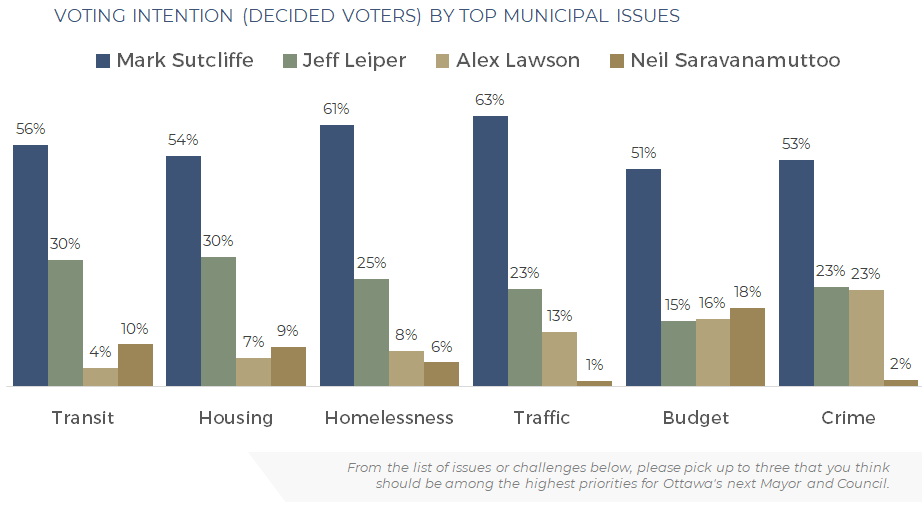
Among residents who select each of the six leading priorities, Sutcliffe remains the leading candidate in every case. Among those prioritizing housing, he receives 54% of the decided vote; 56% among those prioritizing transit; 63% among those prioritizing traffic congestion; 61% among those prioritizing homelessness, 51% among those prioritizing the City budget and 53% among those prioritizing crime.
This is an important counterweight to any interpretation that a particular problem automatically belongs to the opposition. Even among residents who identify major challenges facing the city, the incumbent currently retains a plurality or majority of decided voter support. The challengers therefore need to do more than establish that a problem exists; they need to persuade voters who care about that problem that a change in leadership will be more likely to produce the results they demand.
That said, there are some differentiations among the three main contenders. Leiper is the clear second-place candidate among residents prioritizing housing or transit, while Lawson performs comparatively better among those prioritizing the budget or crime than he does among those prioritizing any of the other issues.
Click HERE to download data table 1 for this report.
Click HERE to download data table 2 for this report.
Click HERE to download data table 3 for this report.
Click HERE to download data table 4 for this report.
Click HERE to download data table 5 for this report.
What is the Quorus metroVox?
Every quarter, Quorus conducts an online survey of n=500 residents of the NCR (400 in Ottawa and 100 in Gatineau), with sampling carefully controlled to be reflective of residents 18 years of age and older.
The survey results presented in this document were derived from a study designed and executed by Doug Anderson. They represent the opinions of 508 randomly selected members of Leger’s opt-in panel, 18 years of age and older, who completed an online survey between June 16-23, 2026.
The data are weighted to replicate actual population distributions by age and gender within region, according to the most recent Census data available. A margin of error could not be calculated due to the use of a non-probability sample, i.e. respondents were selected only from among those who had registered to participate in online surveys through a panel. Respondents had the option to complete the survey in either English or French.
To inquire about our research findings or media availability, contact This email address is being protected from spambots. You need JavaScript enabled to view it. (613-293-2312)
 Accredited Member of CRIC