
Ottawa’s next municipal election is October 26th, 2026. While the race for Mayor remains competitive, the issues that are driving voter decisions are becoming increasingly clear. Quorus’ latest survey finds that Ottawa voters are primarily influenced by housing and affordability, transportation and fiscal management.
Quorus Consulting conducted a survey of 807 Ottawa residents from October 8 to 15. This release also compares results to what we found when we surveyed 403 Ottawa residents from June 16 to 23.
What Voters Are Looking For
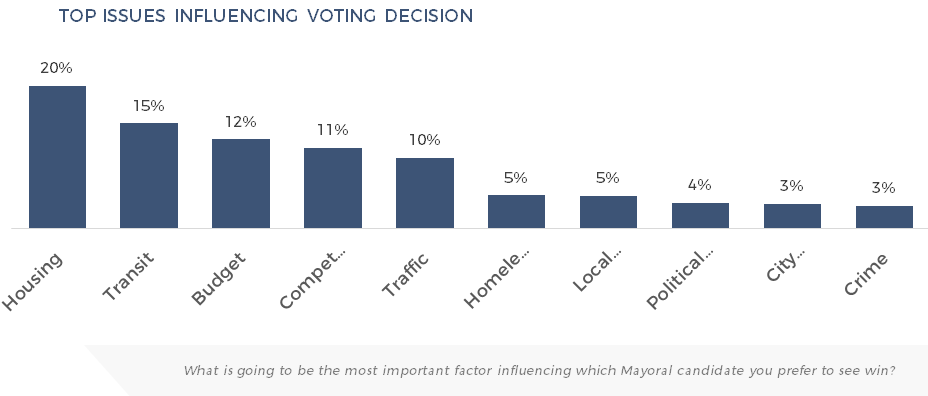
To better understand what is driving vote choice in the mayoral race, we presented respondents with a list of municipal issues and asked them to identify the single most important issue influencing their decision when selecting a preferred candidate.
Ottawa voters’ priorities are concentrated around five leading concerns: housing, affordability and the cost of living rank first (20%), followed by transit and related concerns about OC Transpo and the LRT (15%). Additional top concerns include responsible fiscal management (12%), confidence in a candidate’s leadership and integrity (11%), as well as roads, traffic and transportation (10%).
Taken together, these five issues account for roughly two-thirds of all responses, suggesting that the outcome of the election is likely to be driven largely by how voters evaluate candidates on affordability, transit, fiscal management, leadership, and transportation.
Demographic Differences
While the overall ranking of issues is relatively consistent across demographic groups, there are meaningful differences in emphasis.
Housing and affordability resonate particularly strongly among women, younger residents, renters and lower-income households. Among renters, more than a third identify affordability-related issues as their primary concern (34%), making it by far the dominant issue within that segment. Younger voters (31%) and those with household incomes below $60,000 (38%) also place considerably greater emphasis on affordability than older and more affluent residents.
Regionally, the issue landscape is broadly similar throughout Ottawa. However, residents of Ottawa West are notably more likely than those elsewhere to prioritize roads, infrastructure and traffic concerns (15%).
The Issues Most Likely to Move Votes
One of the more revealing findings emerges when examining those who say there is still a chance they could switch their vote before election day.
Among persuadable voters, housing and affordability clearly stand apart from every other issue (32%), more than double the proportion citing another specific concern. This suggests that while many voters have already settled on a preferred candidate, the remaining fluid portion of the electorate is disproportionately focused on affordability challenges.
Different Issues, Different Candidates
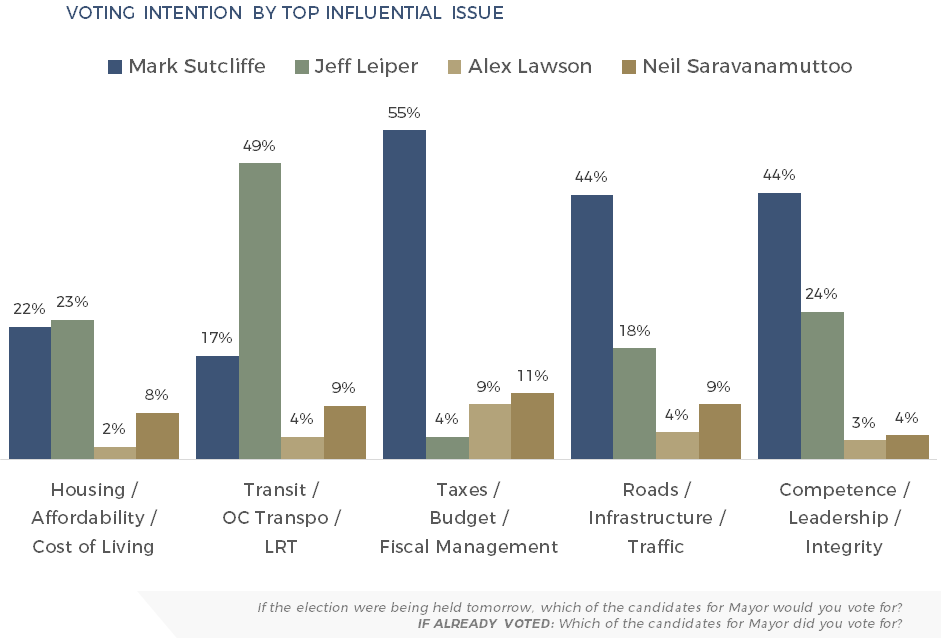
Looking at voting intention through the lens of voters’ most important issue reveals that candidates are drawing support from very different motivations. Percentages reported below are based on all respondents rather than only decided voters.
Among those who identify housing, affordability or cost of living as their primary concern, the race is effectively tied. With nearly an even split among those who prioritize affordability supporting Mark Sutcliffe (22%) or Jeff Leiper (23%), this issue represents a highly competitive battleground between the two leading candidates.
By contrast, Mark Sutcliffe enjoys a substantial advantage among voters most focused on fiscal management (55%), competence and leadership (44%), or roads and infrastructure (44%).
Jeff Leiper's strongest issue advantage comes among transit-focused voters. Those who identify OC Transpo, transit service and the LRT as their top concern are considerably more likely to support Leiper than Sutcliffe (49% vs. 17%).
A Transportation Divide Worth Watching
One broader finding deserves particular attention. At first glance, transportation appears to be one of the dominant themes of the election. However, the data suggest that "transportation" is not a single issue but rather two distinct and politically meaningful issues.
Voters focused primarily on public transit tend to have different candidate preferences than those focused primarily on roads, infrastructure and traffic. Transit-oriented voters are much more likely to favour Jeff Leiper, while those focused on roads and infrastructure lean more heavily toward Mark Sutcliffe. As a result, surveys that combine roads, traffic and transit into a single transportation category risk obscuring an important divide within the electorate. While both groups care deeply about how people move around Ottawa, they often have very different views on which transportation priorities City Hall should be emphasizing and, consequently, which candidate is best positioned to deliver on them.
Click HERE to download a PDF version of this report.
Click HERE to download data table 1 for this report.
Click HERE to download data table 2 for this report.
Click HERE to download data table 3 for this report.
Click HERE to download data table 4 for this report.
Click HERE to download data table 5 for this report.
What is the Quorus metroVox?
Every quarter, Quorus conducts an online survey of n=500 residents of the NCR (400 in Ottawa and 100 in Gatineau), with sampling carefully controlled to be reflective of residents 18 years of age and older. To cover the Ottawa mayoral race, this special edition of the metroVox was held with over n=900 residents of the NCR (807 in Ottawa and 151 in Gatineau).
The survey results presented in this document were derived from a study designed, executed and sponsored by Quorus Consulting. They represent the opinions of 807 randomly selected members of Leger’s opt-in panel, Ottawa residents, 18 years of age and older, who completed an online survey between October 8-15, 2026.
The data are weighted to replicate actual population distributions by age and gender within region, according to the most recent Census data available. A margin of error could not be calculated due to the use of a non-probability sample, i.e. respondents were selected only from among those who had registered to participate in online surveys through a panel. Respondents had the option to complete the survey in either English or French.
To inquire about our research findings or media availability, contact This email address is being protected from spambots. You need JavaScript enabled to view it. (613-293-2312)
 Accredited Member of CRIC