
Ottawa’s next municipal election is October 26th , 2026. Right now, that feels like ages from now, but it is only four months away and a survey that just wrapped up suggests some of the candidates have their work cut out for them between now and then. So, Ottawa residents should expect to hear from them.
Quorus Consulting conducted a survey of 400 Ottawa residents from June 16 to 23 and included several questions about the Mayoral race.
The Mayoral Horse Race Numbers
In terms of the vote intention horse race, only 47% of respondents identify a preferred candidate. While this may seem surprisingly low and suggest there are a lot of voters yet to make up their minds, it’s worth noting that turnout for
municipal elections is notoriously low and, in fact, only 43% of eligible voters cast a ballot in Ottawa’s last election four years ago. Therefore, it is plausible that those offering a response today adequately represent all the people who will ultimately cast a ballot in the Fall.
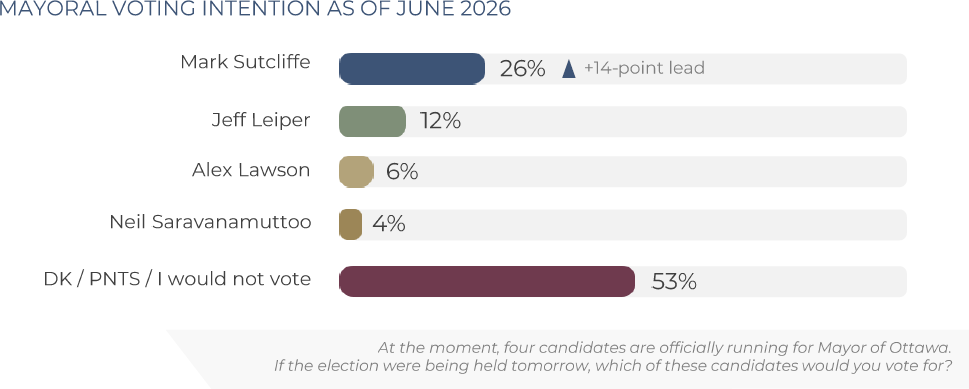
If the election were held now, Mayor Mark Sutcliffe would be re -elected by a fairly wide margin, with Jeff Leiper coming in second and Alex Lawson and Neil Saravanamuttoo with significantly less support.
Among all residents, 26% say they would vote for Sutcliffe; 12% for Leiper; 6% for Lawson and 4% for Saravanamuttoo; and 53% do not offer a preference, either because they do not know (45%), prefer not to answer (3%) or would not vote (5%).
Among decided voters, that means the race is currently: 54 % Sutcliffe, 25% Leiper, 13% Lawson, and 8% Saravanamuttoo.
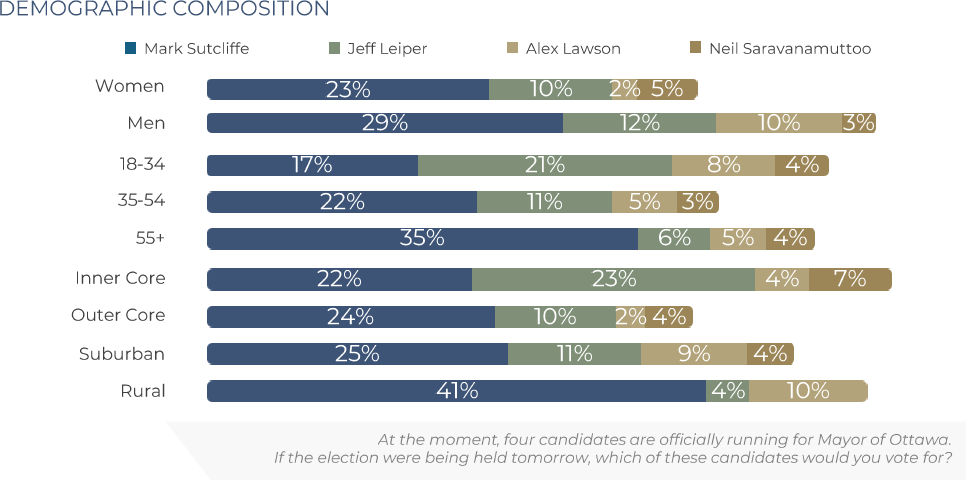
Across the city, Sutcliffe leads everywhere but Ottawa Centre, where he is tied in support with Leipe r. Sutcliffe leads among the important segment of those aged 55 or older, but the lead is much smaller among those aged 35 -54 and Leiper is leading among those under 35 years of age. In terms of gender, Sutcliffe again leads among both men and women, but one result that stands out is that Alex Lawson is performing much more strongly among men than women.
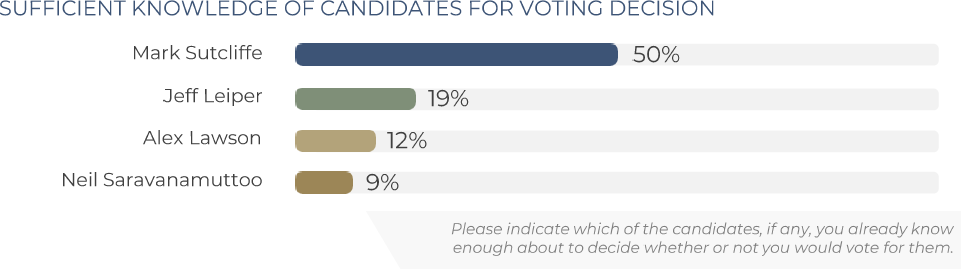
Historically, name recognition has been a very powerful driver of vote in municipal elections. Given that fact, for each of the four candidates, we asked Ottawa residents whether they felt they knew enough about that candidate to decide whether or not to vote for them. The results reinforce the notion of the power of name recognition. Sutcliffe is the only candidate for whom even half (50%) feel they know enough to make an informed decision at the voting booth. With Leiper, the proportion is far lower ( 19%), while Lawson finds 12% and Saravanamuttoo 9% feeling they know enough about the candidates.
What Voters Are Looking For
To better understand what Ottawa voters feel this year’s campaign is about we asked the open -ended question, “What is going to be the most important factor influencing which Mayoral candidate you prefer to see win?”
The responses suggest that this is currently being considered primarily as a question of municipal management rather than ideology. Three broad priorities dominate the discussion: fixing transit, managing taxes and city finances responsibly, and improving affordability (particularly housing). Very few respondents mentioned specific candidates, indicating that voters are currently focused more on issues than personalities.
A review of these qualitative responses finds:
 Transit most broadly defines the agenda ( 17% mentioning). Transit and OC Transpo were by far the most frequently mentioned issue. Respondents focused on reliability, the LRT, bus service, and restoring confidence in municipal service delivery.
 Fiscal management is nearly as important (15%). Many respondents emphasized keeping taxes low, managing the budget responsibly, reducing waste, and improving financial transparency.
 Affordability is also a central concern (11%). Cost of living, affordable housing, rents, and housing supply were commonly cited, usually framed as part of a broader affordability challenge.
 Competence (7%) outweighs ideology or political values (4%). Relatively few respondents focused on political ideology or specific candidates. More commonly they wanted an honest, competent mayor who could get things done.
 Roads and infrastructure matter, but somewhat less ( 6%). Residents frequently mentioned roads, traffic congestion, infrastructure renewal, and suburban growth.
 Homelessness (5%) and public safety (4%) are linked. Many respondents discussed homelessness, addiction, mental illness, street disorder, crime, and policing together as quality -of -life issues.
Main Reason for Supporting Each Candidate
We also asked decided voters why they say they would vote for the candidate they selected. The results offer some qualitative insight into how each candidate is viewed by their respective supporters. Because Alex Lawson and Neil Saravanamuttoo have smaller numbers of supporters in the sample, findings for those candidates should only be considered directional.
Mayor Mark Sutcliffe
Support is driven primarily by confidence in his stewardship rather than enthusiasm for a single issue. Sutcliffe’s voters repeatedly describe him as experienced, competent and deserving another term.
Illustrative quotes:
“Good mayor.” “Done a reasonable job.” “He deserves to continue.” “Has a good record.” “Continue his mission to improve life in Ottawa.”
Jeff Leiper
Supporters emphasize values and community. Housing, neighbourhoods, transparency, climate and social priorities appear much more frequently than managerial themes.
Illustrative quotes:
“Cares about neighbourhoods .” “Affordable housing.” “Progressive.” “Active in the community.” “Because he isn't Mark Sutcliffe.”
Alex Lawson
Support for Lawson is centred on fiscal conservatism and business-oriented management. His voters portray him as a practical outsider who would run City Hall more efficiently.
Illustrative quotes:
“Businessman.” “No nonsense.” “Fiscally conservative.” “Fresh perspective.” “Financial transparency”
Neil Saravanamuttoo
Supporters frequently mention his ideas, intelligence and evidence-based approach. Several indicate they have read his platform or appreciate his economics background.
Illustrative quotes:
“Good ideas.” “Background in economics.” “Honest.” “Fact -based.” “Transit plan.”
Clearly, the candidates occupy notably different political and psychological spaces. Sutcliffe is supported largely because voters trust his experience and continuity. Leiper's support tends to be more values -driven and rooted in community and progressive priorities. Lawson attracts voters looking for fiscal discipline and business -like management. Saravanamuttoo's supporters are drawn to his ideas, intelligence and evidence -based approach. Rather than competing on identical attributes, each candidate currently appears to have a distinct rationale for support.
Click HERE to download this report.
Click HERE to download the data tables for this report
What is the Quorus metroVox?
Every quarter, Quorus conducts an online survey of n=500 residents of the NCR (400 in Ottawa and 100 in Gatineau), with sampling carefully controlled to be reflective of residents 18 years of age and older.
The survey results presented in this document were derived from a study designed and executed by Doug Anderson on behalf of Quorus with no outside sponsor. They represent the opinions of 403 randomly selected members of Leger’s opt-in panel, Ottawa residents, 18 years of age and older, who completed an online survey between June 16-23, 2026.
The data are weighted to replicate actual population distributions by age and gender within region, according to the most recent Census data available. A margin of error could not be calculated due to the use of a non-probability sample, i.e. respondents were selected only from among those who had registered to participate in online surveys through a panel. Respondents had the option to complete the survey in either English or French
To inquire about our research findings or media availability, contact This email address is being protected from spambots. You need JavaScript enabled to view it. (613-293-2312)
 Accredited Member of CRIC